
OSHA Hazard Communication for Construction Training
29 CFR 1926.59 & 29 CFR 1910.1200

Bulk Pricing
Save more when you purchase multiple seats for your team.
Need more than 100 seats? Contact our sales team for custom enterprise pricing.
Get Your Construction HazCom Certification Online | OSHA Hazard Communication Standard Training for Construction Workers | 29 CFR 1926.59 & 29 CFR 1910.1200
Product Details
Description
This OSHA Hazard Communication (HazCom) training is tailored specifically for the construction industry. The course covers the essential knowledge and skills needed to identify, understand, and protect yourself and others from chemical hazards in construction workplaces, including silica dust during concrete work, lead-based paint in renovation projects, solvents, acids, welding fumes, and potentially asbestos-containing materials.
Construction sites present unique chemical hazard challenges with changing work environments, multiple employers working simultaneously, temporary job locations, and mobile work areas. This training addresses these challenges while ensuring compliance with OSHA’s Hazard Communication Standard (29 CFR 1910.1200) as applied to construction through 29 CFR 1926.59, plus substance-specific standards under 29 CFR 1926 Subpart Z.
Reviews
Course Includes
- Interactive Training Modules
- Real-World Case Studies
- Mindful Minute
- Final Assessment
- Ergonomics Break
- Instant Certificate Upon Completion
- Lifetime Access to Resources
- Mobile-Friendly Learning Platform
Core OSHA HazCom Training Topics for Construction
- Understanding Hazardous Chemicals in Construction
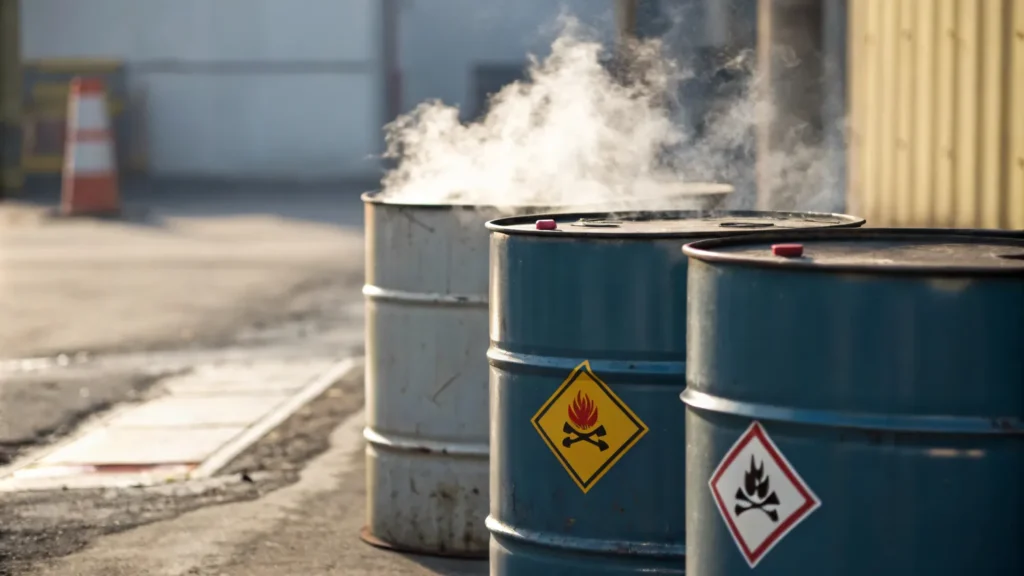
- GHS Labels and Pictograms for Construction Materials
- Safety Data Sheets (SDS) for Construction
- Multi-Employer Worksite HazCom Responsibilities
- Respirable Crystalline Silica
- Asbestos in Construction Lead in Construction
- Other Construction Chemical Hazards
- Emergency Response and Spill Management
- Personal Protective Equipment for Construction Chemical Hazards
- Compliance and Recordkeeping
Who This Course is For
- Concrete workers and masons
- Painters and coating applicators
- Welders and metal workers
- Demolition and renovation workers
- Roofers and waterproofing installers
- Flooring and tile installers
- HVAC technicians
- Electricians and plumbers
- General laborers
- Site supervisors and safety coordinators
Work Settings
- Commercial and industrial construction
- Residential construction and renovation
- Demolition operations
- Road work and infrastructure projects
- Utility installation
- Historic building renovation
- Industrial facility maintenance
- Multi-employer construction worksites
- Any construction site with hazardous chemical exposure
Additional Product Details
Why Choose This Construction HazCom Certification?
OSHA 29 CFR 1926.59 Training
Helps you meet OSHA Hazard Communication Standard requirements as applied to construction through 29 CFR 1926.59, including integration with substance-specific standards under 29 CFR 1926 Subpart Z for silica, asbestos, lead, and other regulated materials.
Construction-Specific Focus
Unlike general industry HazCom training, this course addresses unique construction challenges:
- Multi-employer worksite coordination
- Changing work environments and temporary job locations
- Construction-specific chemical hazards (silica, lead, asbestos)
- Weather-resistant labeling and mobile SDS access
Immediate Certificate Access
Upon completion, receive your printable Construction HazCom Training Certificate instantly—valid for documenting OSHA-required hazard communication training for construction workers.
Flexible Online Learning
- Complete training at your own pace
- Access from any device (computer, tablet, mobile)
- No scheduling conflicts or travel required
- Affordable alternative to in-person classroom training
OSHA Training Requirements | 29 CFR 1926.59
When HazCom Training Is Required:
- At the time of initial assignment to work with hazardous chemicals
- When new chemical hazards are introduced into the work area
- When assigned to new construction projects with different chemical hazards
- When working with substances requiring specific training (silica, asbestos, lead)
- When construction phases change and new materials are introduced
- As refresher training per employer policy
- When entering multi-employer worksites with unfamiliar chemical hazards
Frequently Asked Questions
How long does construction HazCom training take?
This online construction hazard communication certification takes approximately 2-3 hours to complete, including the final exam. You can work at your own pace and pause/resume as needed.
What score do I need to pass?
You must achieve a minimum score of 70% on the final assessment. You have up to 3 attempts to pass.
What are the 16 sections of an SDS?
The 16 standardized SDS sections are: (1) Identification, (2) Hazard Identification, (3) Composition/Ingredients, (4) First-Aid Measures, (5) Firefighting Measures, (6) Accidental Release, (7) Handling and Storage, (8) Exposure Controls/PPE, (9) Physical/Chemical Properties, (10) Stability and Reactivity, (11) Toxicological Information, (12) Ecological Information, (13) Disposal Considerations, (14) Transport Information, (15) Regulatory Information, (16) Other Information.
What is the OSHA PEL for crystalline silica?
The OSHA Permissible Exposure Limit (PEL) for respirable crystalline silica in construction is 50 micrograms per cubic meter (μg/m³) as an 8-hour time-weighted average. The Action Level is 25 μg/m³, which triggers exposure monitoring and medical surveillance requirements.
What are the four employer types on multi-employer worksites?
OSHA’s Multi-Employer Citation Policy defines four categories: Creating Employer (causes the hazard), Exposing Employer (employees exposed to hazard), Controlling Employer (general supervisory authority over worksite), and Correcting Employer (responsible for correcting the hazard). Each has specific HazCom responsibilities.
How long must SDS records be retained?
Safety Data Sheets must be retained for at least 30 years, even after the chemical is no longer used in the workplace. Training records must be kept for the duration of employment plus 5 years after departure. Exposure monitoring records must be retained for 30 years.
What signal word indicates the most severe hazard?
“Danger” is reserved for the most severe hazards (such as highly caustic concrete cleaners), while “Warning” applies to less severe but still dangerous chemicals. These are the only two official GHS signal words.
What type of gloves should be used for cement work?
Cotton-lined PVC gloves are recommended for cement work to prevent chemical burns from the highly alkaline materials in cement. These gloves provide protection against both the chemical hazards and the abrasive nature of cement while improving comfort during extended wear.
$41.95
Bulk Pricing
Save more when you purchase multiple seats for your team.
Need more than 100 seats? Contact our sales team for custom enterprise pricing.